
A couple of weeks ago I was in New York City as a guest on a show, and before the taping I spent some time walking the streets. I remember New York from years past as a city that hit you the moment you stepped onto the sidewalk. People argued, laughed, hustled, sized you up, and met your eyes whether you wanted them to or not. There was a charge in the air, a collective pulse you could feel in your chest.
That is not what I felt this time.
The crowds were as thick as ever, pouring in every direction, but the charge was gone. Nearly everyone had AirPods in, sealed inside a private soundtrack, eyes fixed on a phone or on some point a few feet ahead. Hundreds of people passed within inches of me, and I could count on one hand the faces that registered I was there. When I did catch someone’s eyes, I found a look I know well, because I have seen it across from me in my office more times than I can count. The gaze was open and aimed forward, yet nothing landed. There was no spark, no curiosity, not even irritation, and it was the same block after block.
It was the look of a woman I call Amanda, whose story opens my new book. She was twenty-eight and taking four psychiatric drugs when she first walked into my office, and her large brown eyes had something behind them that had been turned down, the way you might dim a light without ever switching it off.
Years earlier, three days after she tried to die, a psychiatrist she had known for fifteen minutes told her she had Bipolar Disorder and would need drugs for the rest of her life. He never asked what had happened to her, so he never learned about the stepfather who began abusing her at fourteen, or that she had believed ever since that it was her fault and she was permanently damaged. His diagnosis simply gave that belief a medical name. When I asked Amanda what brought her in, she said, “I am bipolar.”
For twenty years I saw eyes like hers mostly in clinical settings. What shook me in New York was finding them on a crowded sidewalk, in ordinary people on an ordinary day, as though that look had quietly become the new normal.
I call it what it is. Dead eyes.
On psychiatric units the look is so familiar that staff learn to recognize it within days, and families see it across the dinner table as they quietly grieve someone who is physically present and somehow gone.
When a person who once felt everything has been brought to the point of feeling almost nothing, the mental health system records a treatment that is working. Inside, that person has become less alive: sedated, blunted, and dark. Everything that makes them human has been turned down to a manageable level.
Who benefits from a population that sees itself as mentally ill for responding to abuse? Who benefits from a population that is sedated, blunted, and apathetic?
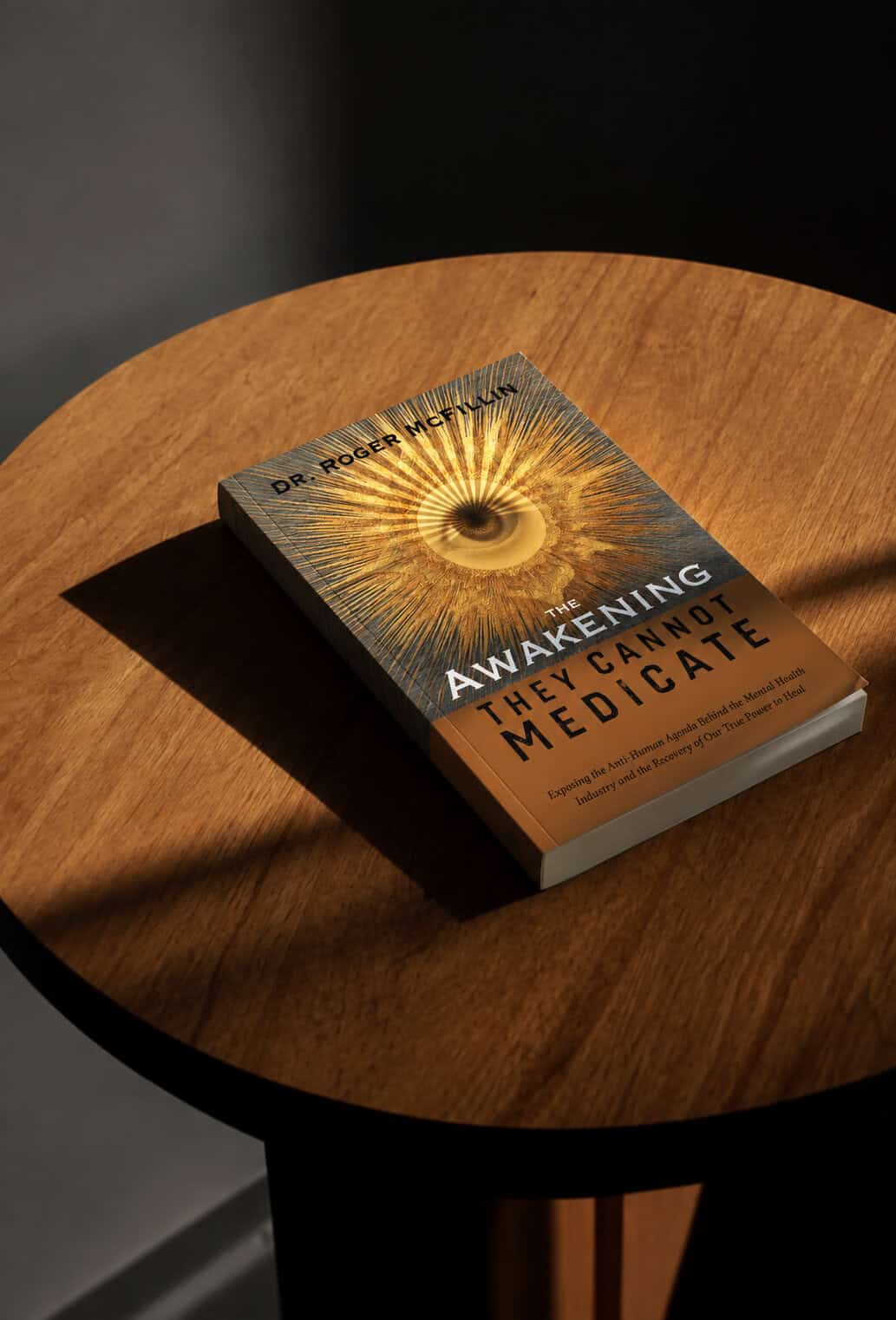
That is why the cover of my book is a single eye at the center of a burst of gold light. It holds the whole argument in one image.
Most people are not ready to hear the rest.
That light is under attack, and the scale of the attack is staggering. Roughly one in 4 or 5 American adults takes a psychiatric drug in any given year, most of them long term, and in a national survey this year nearly half of Americans said they had been prescribed one at some point in their lives. Walk into this system in pain, and the odds are overwhelming that you will walk out with a dangerous drug.
That is not a healing profession. It is a captured one, trained by an industry that profits from managing people for life and rewarded for keeping them dim, disconnected, and compliant. The drugs that blunt emotional energy are only the front line, backed by screens that capture attention, food that poisons the body, and a story insisting your deepest pain is a defect in your brain. A person who knows they carry the light of their Creator cannot be sold that story, which makes them dangerous to the machine. That is why I believe the most important movement of our time is a pro-human one, made up of people waking up to what they are and refusing to let anyone turn the light down again.
Part One of my book makes the case that we are living under an anti-human agenda, one that reduces the soul to brain chemistry and treats a human being as a machine in need of adjustment. Through that lens, dead eyes are no unfortunate side effect. Grief, fear, rage, and longing are the soul announcing that something needs attention, and a culture that has forgotten what ordinary human suffering looks like has decided those signals are the disease.
Becoming the Light
If dead eyes were the whole story, I would have written one more critique of psychiatry. What I set out to write instead was an answer to the question readers keep asking me in one form or another: if not this, then what?
The answer did not come from graduate school or following the authoritative guidance in my field. Beginning in 2020, a series of profound spiritual experiences overturned my understanding of reality and showed me I had been missing the mark in how I was helping people.
Then I was trained all over again, this time to sit in silence. I spent long stretches in meditation learning to turn the dial, to quiet the noise of my own mind until I could connect with guidance from higher forms of energy. And the guidance came. It came about my own life and the decisions in front of me, and it came about the people sitting across from me, often with a clarity about what they needed that no assessment had ever given me. I stopped managing suffering from a professional distance and began sitting with people in love, and clients who had been stuck for years began to move in ways I had not seen in two decades of practice. In fact, this book is itself part of that guidance.
That same guidance directed me to study. It began with the teachings of Jesus, which I came to understand from an entirely new perspective, and extended into Jewish mysticism, Hermetic philosophy, quantum physics, post-materialist science, and the vast record of near-death experiences. Across thousands of years, they carry the same message: consciousness is not a product of the brain, and a human being is far more than a physical body.
That is the second half of my book, and I will warn you now: it is where the miracles are. A woman walks into my office on a Monday night, suicidal and hopeless. Less than ninety minutes later I observed light pouring from her eyes, and she tells me she feels better than any drug could ever make her feel. What happened in that room, and what was waiting for me in the parking lot when I walked out, I tell in full in the book. I know how it will sound. I wrote it anyway, because it happened.
Then there is the woman who asked to see me by name and drove a long way to do it. She had survived things many people struggle to recover from, yet she walked into my office radiating a peace I had rarely felt in any human being. Before our work was done she told me why she had really come, and it changed the direction of my life. Every story in the second half of the book turns on that same key, and the book shows you how to use it.
Look at the Eyes Around You
Tonight, look closely at the eyes of the people you love, and then look at your own in the mirror. Watch your child’s eyes when they come home from school. Think about the friend who has been on the same prescription for ten years and no longer seems entirely there. You already know what you are looking for, because some part of you has been noticing it for a long time without a name to give it.
This book is for everyone who has noticed, and that is far more people than many would like to admit. It is for the person handed a diagnosis who suspected it was not the whole truth, the parent whose child was labeled before learning to spell the word, and the clinician lying awake wondering what they have become part of. It is just as much for the friend, the neighbor, the pastor, the grandmother, and the coworker who were told to stay out of it and “refer to a professional,” as though caring for one another required a license.
For most of human history, people in pain were held by their families, their communities, and their faith. We sat with each other through grief, prayed together, hugged them and listened. We received guidance from wise elders. We were connected to nature and served our families and communities. Somewhere along the way we surrendered help to a professional monopoly that decided only credentialed experts were qualified, and then filled its offices with fifteen-minute appointments and prescription pads. We were taught to doubt our own capacity to love someone back to life. That is the right this book asks you to take back.
Taking it back will require you to question healthcare authorities that have rarely answered for what they have done in the name of help, and to challenge a materialist paradigm that insists you are nothing more than functioning body parts. Above all, it requires restoring the connection that was always yours: the divine spark placed in you by your Creator, a light so powerful it is a healing and creative force.
So look again at those eyes. Behind even the dimmest of them the light is still burning, waiting for someone to remember it is there. Let that someone be you.